


Where does the image end and reality begin?
With Fam.Li visits … Baarnse Bos, I am not creating a walking route to which I add art. I am creating an artwork that people can literally walk through.
For me, that distinction is essential. A walking route connects places. An artwork shapes perception. It determines not only where you are, but also how you look.
In this work, digital compositions, historical locations, nature and imagination come together. The artwork does not exist exclusively on a screen or in the landscape, but also emerges through the interaction between them.
A beautiful example is the Sterrenbos.
On a historical map of the former De Eult estate from 1745, the geometry of the landscape becomes visible. Eight avenues converge at the Grote Kom pond. From this perspective, the structure of the design can be seen at a glance. The landscape almost becomes a drawing.
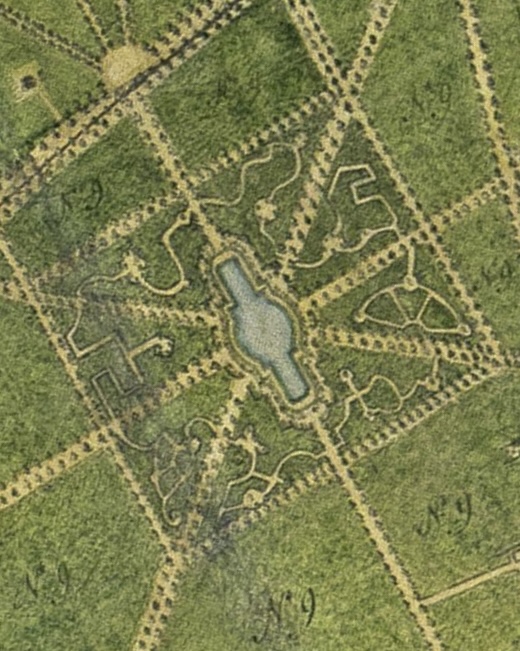
The Sterrenbos and Grote Kom. Rotated detail from the map of the De Eult estate, J. Perk, 1745. Watercolour, pen and brush on paper, ink and watercolour. Original dimensions 150 × 130 cm. Royal Collections, The Hague, inv. no. E09d-K9.
But anyone moving through that same landscape on the ground experiences something entirely different. There is no complete overview, only a succession of paths, trees, openings and directions. You are no longer looking at the design, but find yourself in the middle of it.
As I walked through the Sterrenbos, my GPS recorded my movements. I deliberately followed only part of the historical avenues. A geometric pattern appeared on my screen, this time not as a historical design, but as a record of my own walk.
And then something amusing happened.
At the Grote Kom, the recording stopped. Naturally, I wasn’t going to swim across. I switched off my GPS and resumed the recording on the other side of the water.
On the map, you can see where the lines are interrupted and continue on the opposite shore.
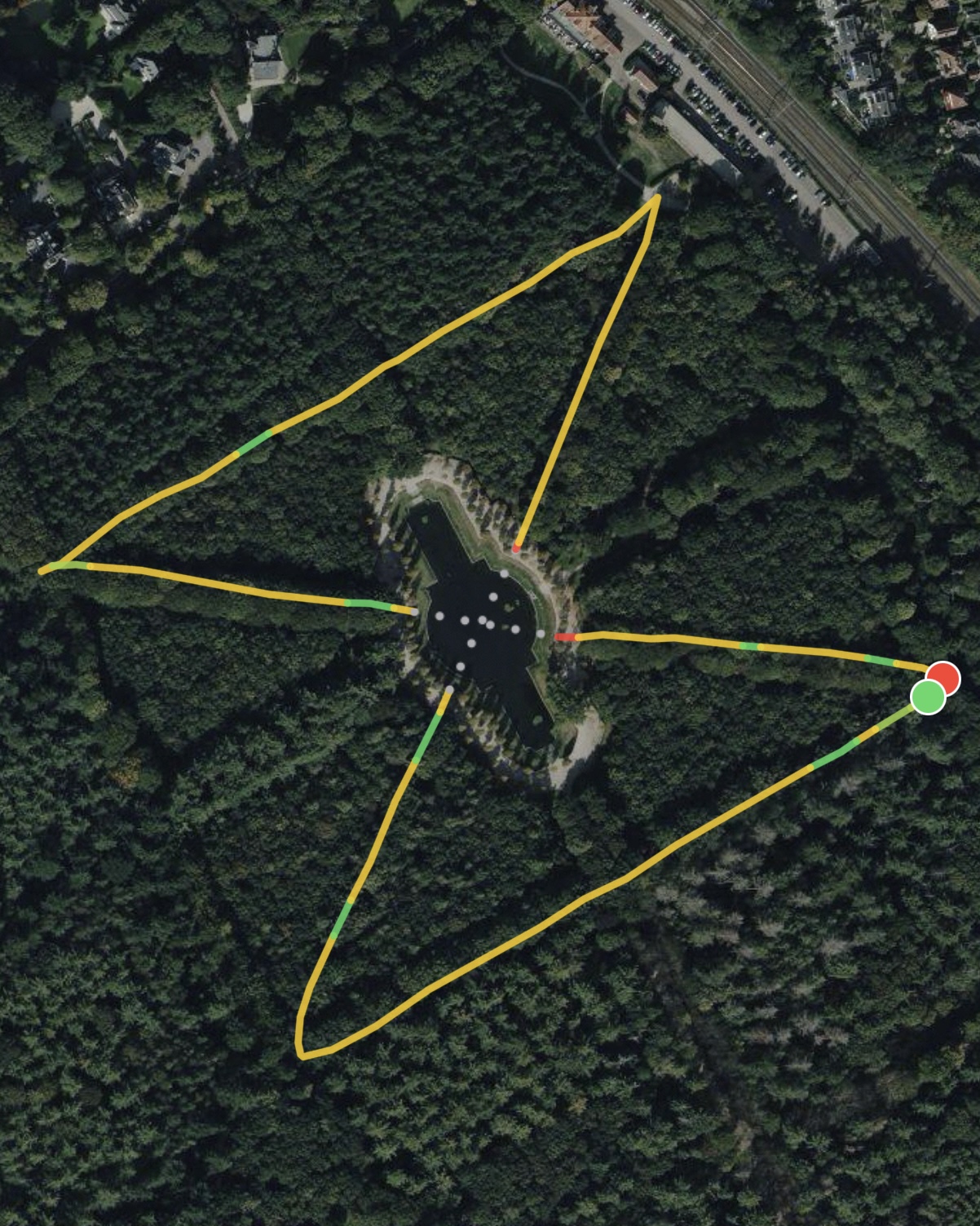
GPS recording of a walk through the Sterrenbos, Baarn, 2026. The route is interrupted at the Grote Kom and continues on the opposite side.
It was precisely at that point that I began thinking about the different realities in which Yana and I move.
Where Yana's path and mine diverge
Yana moves through the same landscape as I do, but not within the same boundaries.
Where I have to interrupt my route, she can continue. I can let her swim, have her use a homemade wooden raft, or even send her across on a jet ski.
That is what makes artistic imagination so interesting to me. Yana does not have to follow my movements literally. I can give her possibilities that I have not explored myself.
She is not a digital reconstruction of my reality, but an artistic character with a world of her own.
And precisely because her world remains connected to existing locations, an interaction emerges between what is real and what I add through imagination.
Three realities come together: the historical reality of the designed landscape, the physical reality of my own experience and the artistic reality in which Yana moves.
For me, this is not about recording a walk or reconstructing a historical pattern, but about the shifts between these realities.
This touches on a question that has been present in my work for a long time: where does the artwork actually exist?
In the digital composition? In the landscape? In the movement of the person walking? Or in the difference between what actually happens and what I can imagine?
For me, the artwork does not reside in any single element, but in the relationships between them.
The visitor also brings their own perspective. Anyone walking through the forest notices different details, makes different choices and experiences the same surroundings in their own way.
In this way, an artwork emerges that cannot be fully understood from a single viewpoint. Not because it is incomplete, but because it can be experienced in different ways.
The historical map shows how the landscape was once designed. My GPS shows how I moved through it. Yana adds a reality that exists only within my artistic imagination.
And the visitor can then connect these different realities for themselves.
You don’t just look at the artwork. You walk through it.

Reacties